
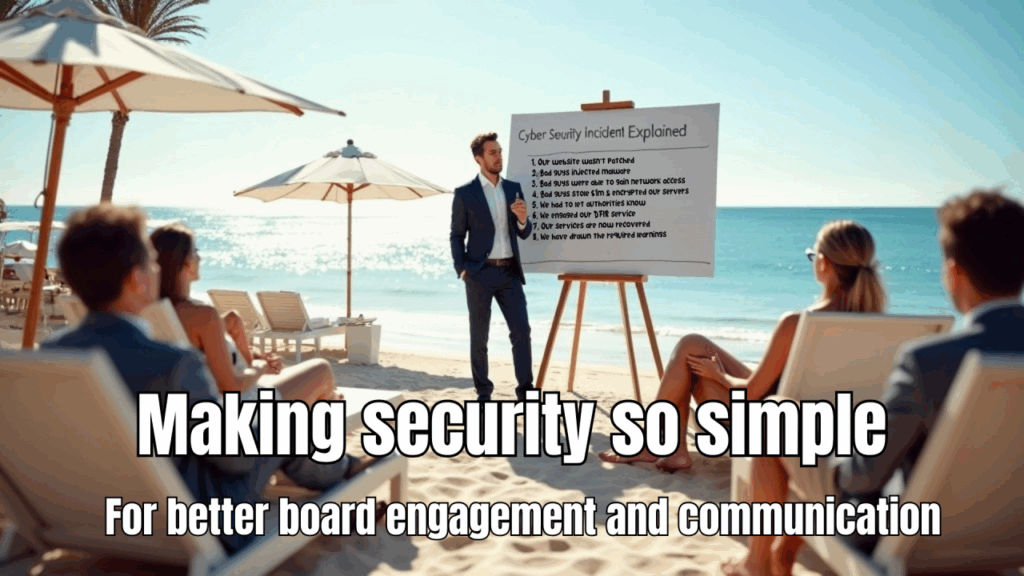
From Tech Jargon to Boardroom Clarity: Why CISOs Must Become Translators, Not Technicians
Boards don’t want packet captures. They want clarity.
Yet many CISOs still walk into boardrooms armed with acronyms, attack trees and war stories. The result? Blank stares.
Take “lateral movement.” To a security team, it’s technical precision. To your board, it’s noise. What they actually need to hear is:
“Attackers rarely stop at the first compromised laptop. They move sideways until they reach your crown jewels. Without controls in place, it’s like leaving every internal door in your office unlocked.”
The trick isn’t dumbing things down. It’s shifting from technical depth to business impact:
“Our current exposure means an attacker could go from a compromised intern’s laptop to our customer database in under a week. We need controls to close those doors.”
This is the pivot CISOs must master heading into 2026.
Why this matters now
The last two years have been a turning point:
- Board dissatisfaction remains high. Less than 15% of board members say they’re satisfied with the cyber risk information they receive
- Regulation has teeth. SEC rules in the US mandate 4-day disclosure of material cyber incidents. In Australia, SOCI and APRA CPS 234 put boards personally on the hook
- The stakes are massive. Cybercrime is forecast to cost $10.5 trillion annually by 2026
Boards don’t have the luxury of “not getting it” anymore. CISOs don’t have the luxury of hiding behind acronyms.
The communication gap: why boards tune out
Three reasons why even the sharpest security briefings fail to land:
- Different languages. CISOs think in CVEs and attack vectors. Boards think in revenue, liability and strategy
- Mismatched time horizons. Security leaders obsess over immediate threats. Boards weigh those against long-term investments.
- Complexity aversion. When presented with technical laundry lists, most directors disengage.
As one board chair put it to me bluntly: “Don’t tell me about your firewall. Tell me if my company will be on the front page of the AFR.”
Trends reshaping board conversations in The last 2 years
1. Regulation forces business language
- US: SEC rules demand boards disclose cyber oversight in annual reports. “Materiality” is now a financial, not technical, threshold
- Australia: SOCI Act requires board-signed annual risk reports, with evidence of effectiveness
2. Quantification over heatmaps
The old RAG (Red/Amber/Green) risk charts don’t cut it. Boards need Cyber Risk Quantification (CRQ)—loss expectancy in dollars.
- A Fortune 500 bank recently showed its board: “20% probability of losses exceeding $17m over the next 12 months.” That got funding approved
- FAIR has become the go-to model, moving conversations from “lots of CVEs” to “$26m annualised loss exposure reduced by 70% through one investment
3. AI and quantum loom large
- AI threats: A UK firm lost $1.2m earlier this year to a deepfake voice attack mimicking its CEO
- Quantum risk:Boards don’t want an encryption lecture. They want to know why
4. Industry case studies show the way
- Financial services: Link security directly to digital revenue growth. Example: a $50m AI-powered detection investment reducing expected annual losses by $60m while enabling $200m new revenue
- Healthcare: Frame cyber as patient safety, not IT. “A ransomware attack could shut down care systems for 48 hours, directly impacting 2,500 patients.”
- Manufacturing: Talk production lines. “A five-day OT shutdown would cost $45m plus $15m in penalties.”
How to Translate Without Losing the Plot
Here are proven tactics CISOs are using recently to avoid the blank stares:
What → So What → Now What.
- What happened? “Phishing simulation showed 15% staff click rate.”
- So what? “Could trigger downtime, $5m in fines, trust erosion.”
- Now what? “Rolling out multi-factor authentication and training to cut exposure.”
Analogies that stick.
- Zero Trust: Treat every door inside HQ like the front door—everyone re-badges in.
- MFA: Your house key plus a thumbprint.
- Supply chain risk: Like relying on a parts supplier you can’t audit.
Lead with financials, not firewalls. Show impact in EBIT, revenue, or insurance premiums. Example: “Reducing mean time to respond from 8 hours to 4 saves $3.9m per breach.”
Wrap facts in stories. A fact is 22x more memorable in story form
The Forward Path: 2026 and Beyond
The direction of travel is clear:
- CISOs as translators, not technicians. Success depends on fluency in finance and strategy as much as in cyber.
- Security as enabler. Boards fund what grows the business, protects customers, and builds trust.
- Jargon is dead weight. If you can’t explain it in two minutes without acronyms, you’ll lose your audience.
One CISO told me they start every board deck with this line:
“Here’s what could stop us making money next quarter, and here’s what I’m doing about it.”
Simple. Sharp. Effective.
Takeaways for Security Leaders
- Stop leading with vulnerability counts. Lead with business impact.
- Use CRQ and FAIR to anchor cyber risk in financial terms.
- Build board fluency in AI and quantum risks now, not later.
- Learn from industries that already cracked the code (FSI, healthcare, manufacturing).
- Remember: the goal isn’t to impress with jargon. It’s to equip the board to make informed, defensible decisions.
Security is not going to get simpler. If anything, digital transformation will make it more volatile, with constantly shifting environments that make it harder to measure risk and maintain posture. The role of the CISO as a translator is no longer optional. It is becoming critical to the long-term resilience of organisations. Heading into 2026, this is a skill every CISO must master.