
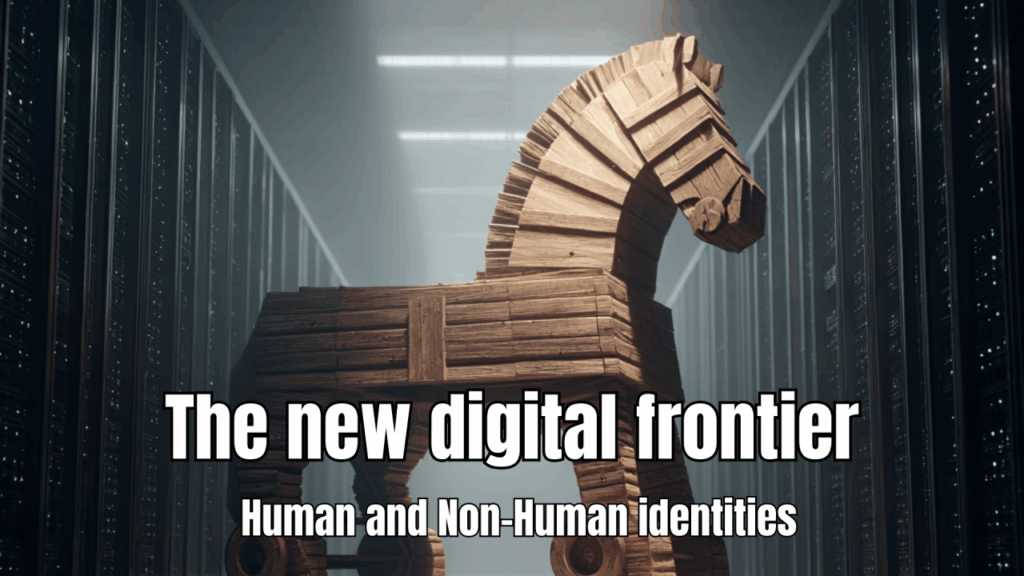
Non-Human Identities: The Silent Saboteur of Digital Transformation
How machine and workload identities have become the soft underbelly of modern enterprise security
“It’s not the 10,000 employees you onboarded last year that scare me. It’s the 1.2 million secrets, tokens, and ephemeral compute identities no one tracks.”
The hard facts,
- Machine identities now outnumber human identities 45:1 in cloud-native environments
- Most orgs lack basic visibility into API keys, service accounts and ephemeral identities
- Leaked secrets and shadow identities are a leading cause of cloud breaches in 2024–2025
- Identity-first architectures (CIEM, secret hygiene, identity graphing) are becoming mandatory
- Predictive, behavioural telemetry is the only scalable approach to managing NHI risk in 2025+
The Identity Perimeter Is Long Gone
In the last 18 months, identity-based attacks have skyrocketed, not necessarily the kind most boards are thinking about.
We’re not talking about compromised user passwords or phishing.
We’re talking about:
- Misconfigured IAM roles
- Hardcoded API tokens in GitHub
- Forgotten cloud service principals
- Over-permissioned workload identities
- Ephemeral containers with inherited secrets
According to the 2025 Gartner IAM Trends Report, over 75% of cloud security incidents involved misuse of non-human identities (NHIs). In a recent joint study from CyberArk and IDC, only 19% of organisations could confidently say they had full visibility of machine identities in production.
Let that sink in: You’re worried about your staff’s password hygiene while your Kubernetes cluster is handing out cloud admin roles like candy on Halloween.
What Exactly Is a Non-Human Identity?
Any identity that’s not tied to a human user but can authenticate, authorise, or access resources.
Examples include:
- Service accounts (on-prem AD, cloud-native IAM)
- CI/CD tokens (GitHub Actions, GitLab runners)
- API keys (public/private, managed or user-generated)
- Cloud functions & workloads (Lambda, Azure Functions, GCP Cloud Run)
- Containers and ephemeral compute with inherited roles
- IoT & edge devices in industrial or healthcare settings
What makes NHIs dangerous?
- They’re often created automatically
- Rarely have expiry or rotation policies
- Typically not monitored in SIEMs
- Frequently retain privileges long after decommission
Unlike humans, NHIs don’t go on holiday. They don’t get MFA. They don’t trigger alerts—until something breaks.
Just How Bad Is It in 2025?
The numbers paint a clear picture:

According to Wiz’s State of Cloud 2025 report,
“40% of critical cloud exposures in the Fortune 500 stem from stale service accounts with admin permissions.”
You wouldn’t give a former contractor perpetual access to payroll, so why are you letting that zombie EC2 role from 2021 still have s3:GetObject on every bucket?
Real Breaches, Real NHI Failures
1. Snowflake Data Breach – a compromised service account with weak OAuth controls enabled credential theft, allowing attackers to exfiltrate large volumes of customer data. Root Cause: API credentials were leaked and not rotated. No behavioural baselining or identity mapping was in place.
2. Shadow CI/CD Tokens in GitHub – In Q1 2025, GitGuardian detected a surge in hardcoded CI/CD secrets linked to high-profile data exfiltration incidents in logistics and fintech. Root Cause: No scanning pipeline for secrets. Over-scoped tokens had access to production databases.
3. Misused Machine Identity in Azure DevOps – a compromised build agent identity was leveraged to inject malicious code into an internal NuGet package in a manufacturing firm. Root Cause: Excessive IAM privileges + no rotation policy + no logging of the agent’s activities.

What Smart Orgs Are Doing in 2025
1. Mapping their Identity graph – like asset inventory, but for identities. Who (or what) has access to what, and why?
- Use one of the many available tools, to create a visual mapping of NHI and where they are being used
- Map NHI lifecycles: creation, rotation, usage, retirement
- Continuously monitor actual usage vs. provisioned access
2. Adopting CIEM (Entitlement Management for Cloud) – because often, cloud IAM is broken by design.
CIEM tools offer:
- Least-privilege enforcement for NHIs
- Automated detection of unused roles & tokens
- Identity drift prevention
“CIEM is to machine identity what EDR is to endpoints.”
3. Building a secret hygiene pipeline – If your DevOps team can’t tell you how secrets are created, rotated, or expired—it’s already too late.
Modern orgs now:
- Use cloud secrets management solutions
- Enforce secrets scanning in every code push (GitHub + Gitleaks or TruffleHog)
- Expire tokens automatically post-job
Guiding principle – secrets should never live longer than the workload they support.
4. Behavioural telemetry for NHIs – humans have baselines. NHIs should too.
- Train ML models on service-to-service communication patterns
- Detect anomalous access spikes, geo-behaviour, or time-based drift
- Combine this with predictive intelligence feeds (TAXII 2.1 / STIX)
Monitoring rule example: alert if a Lambda function downloads sensitive files at 3am when it normally runs 9–5.
What’s Next? NHIs Are Multiplying—Fast
Every time your developer spins up a new workflow, container, or SaaS integration, new identities are born. Most will live in the shadows. Some will be over-privileged. A few will get compromised.
If you don’t control this explosion, it will kill your ability to scale safely.
In 2025, CISOs must:
- Treat NHIs as first-class security citizens
- Integrate secrets and identity hygiene into DevSecOps
- Measure IAM exposure in every risk report
- Include NHI attack paths in purple team exercises
TLDR and ADHD summary and takeaway
You don’t need 1,000 new security tools. You need identity observability. Start with:
- Mapping every NHI in your org
- Enforcing secrets lifecycle management
- Using behavioural baselining + predictive telemetry
- Aligning IAM strategy with DevOps velocity
Non-human identities aren’t an edge case anymore. They’re the attack surface.